### At least I know I’m a huge weirdo.

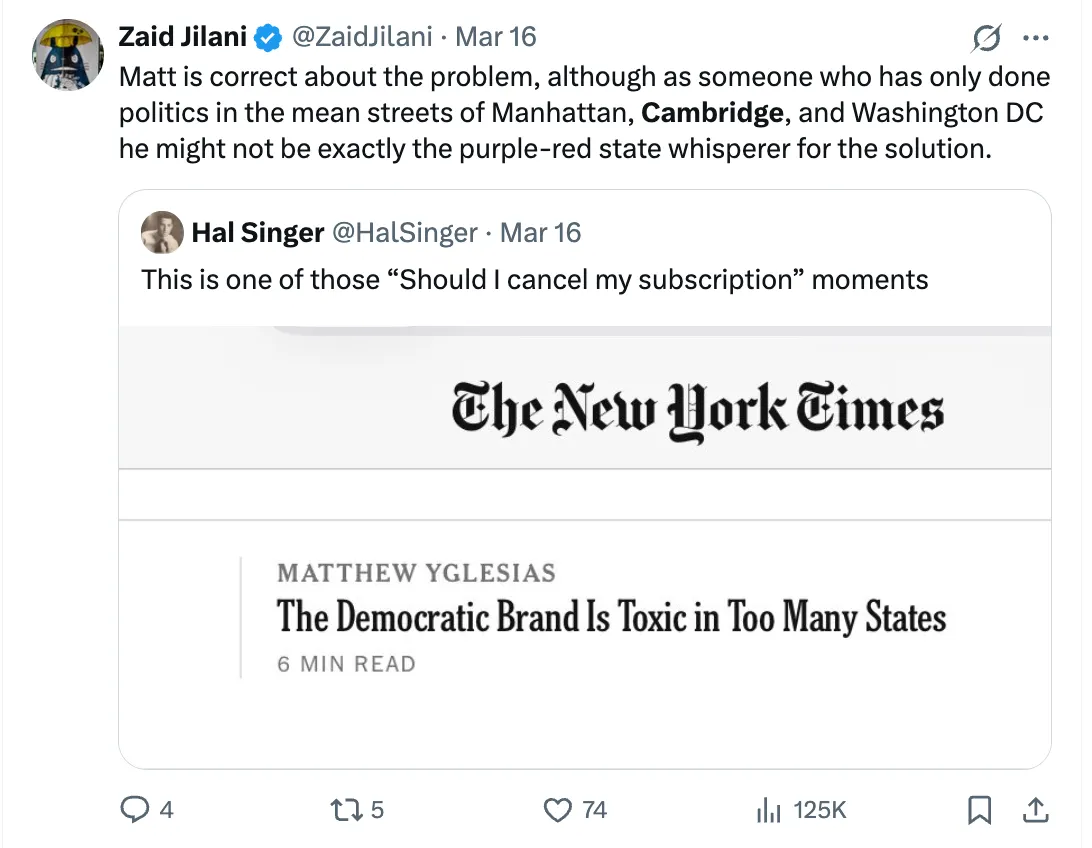
Zaid Jilani had a [funny take on me](https://x.com/ZaidJilani/status/2033617064011739581) recently, which was that even though I’m basically right about things, nobody should listen to me because I’ve lived a comically out-of-touch life.
And it’s true.
I’m not just from Manhattan — I’m specifically from Greenwich Village. My dad is a novelist and screenwriter. My mom was a graphic designer and painter. The men on her side of the family are all economists. My dad’s parents were novelists and journalists and [literal Communist Party members](https://www.slowboring.com/p/reds-in-the-family). Here in D.C., I live in Logan Circle. Not only are my life experiences irrelevant to purple-state electoral politics, they’re just *odd*.[^1]
I once had a conversation with a neighbor who was new to my D.C. neighborhood but used to live in the Boston area. I asked him where and he said the South End, and I said that was my favorite Boston neighborhood because I really felt at home there and that I thought he’d love Logan Circle.
This guy naturally understood me to be saying I was gay, when I’m actually just a weirdo who’s spent the vast majority of his life living in [gayborhoods](https://press.princeton.edu/books/hardcover/9780691158792/there-goes-the-gayborhood?srsltid=AfmBOopuU3ETCyJCnqx-iPJCzyCuUyZury5vSBetE8hdeC-Wb6SsDEKy). The South End just literally reminds me of my hometown!
So Zaid is completely correct about the biographical facts of my life. What I will say on my own behalf, though, is that I am living life without illusions.
Roughly 100 percent of the people who write about politics professionally live in large metro areas (most common) or college towns and attended selective colleges. That itself is an idiosyncratic life experience. But of course it doesn’t *seem* idiosyncratic because if you leave your hometown to attend a selective college and later get a white-collar job in a major metro area, you’ll spend your time surrounded by people who did the same.
As a result, almost everyone ends up being significantly more out of touch than they realize. And one good way to avoid the pitfalls of that is to just know for sure that your intuitions are no good.
#### “A good, hard spanking”
One of my favorite examples of this is the current spanking situation in the United States.
Most of the people I know personally who I’ve asked about it significantly underestimate the share of Americans who agree that “It is sometimes necessary to discipline a child with a good, hard spanking.” But beyond that, even those who know that pro-spanking is fairly widespread and may have grown up in spanking households or communities tend to assume there’s an age gradient. The spankers they know are old, and the younger parents they know are non-spankers.
But this isn’t really what’s going on. In General Social Survey data, senior citizens are the most spanking-skeptical and contemporary parents are if anything more enthusiastic about physical discipline.
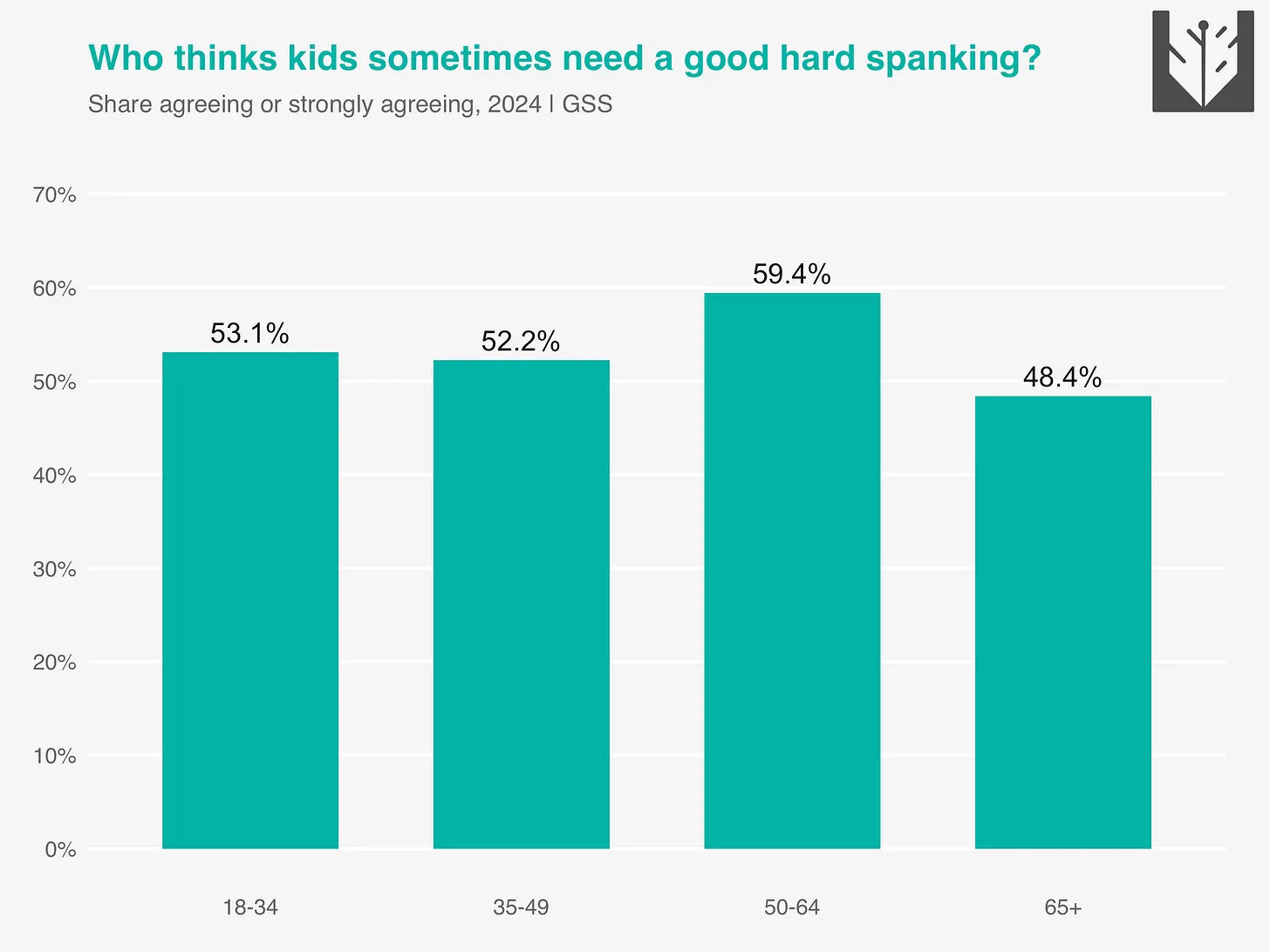
I don’t have any great insight into this either. What I do have is the insight that my whole life has been kind of weird, and that there is usually survey data available if you want to find out what people think about stuff. I first looked this one up years ago, found that other people were surprised by the results, and have always remembered it since. The key thing, though, is that I looked it up.
I keep reading articles [questioning](https://www.newyorker.com/books/under-review/the-harsh-realm-of-gentle-parenting) the [wisdom](https://www.washingtonpost.com/world/2023/04/06/gentle-parenting-caroline-goldman-france/) of the [trend](https://unherd.com/2024/12/the-cruelty-of-gentle-parenting/?edition=us) toward “gentle parenting” or at least asking [whether it’s gone too far](https://www.mother.ly/parenting/is-gentle-parenting-becoming-too-gentle/). But none of these pieces ask whether this trend is even real or interrogate its sociocultural boundaries.
I certainly can think of some parents whose conduct I might characterize as excessively “gentle” in this sense. But that was true when I was a kid, too. I’ve also seen people openly hitting their kids on the metro in D.C. It’s a big world out there. I’m sure the people debating this gentle parenting trend are accurately picking up on some genuine current that’s occurring somewhere in American society.
But most writers and editors seem *so* sure they have their fingers on the pulse of things that they’re making no effort to check what is and is not representative.
#### The whole discourse class is really weird
I went to Harvard, and it’s pretty clear that graduates of Harvard in particular and Ivy League schools in general are overrepresented in the national media. It’s the kind of thing where if you work in the D.C. takes game for any period of time, you’ll eventually learn that eating clubs are a thing at Princeton, secret societies at Yale, and final clubs at Harvard. Ivy alums aren’t an actual majority of D.C. journalists; we’re just sufficiently thick on the ground for these little quirks to be obnoxiously ubiquitous.
One result is that you often meet people who went to the flagship campuses of state universities and are walking around with a chip on their shoulder.
The reality, though, is that these people *also* attended schools that are much more selective — and much more upscale in terms of their family demographics — than the schools attended by a majority of college graduates. The 186 institutions that together comprise the top two selectivity tiers in Barron’s ranking collectively enroll [only 16 percent of total undergraduates](https://www.stlouisfed.org/on-the-economy/2024/dec/who-applies-enrolls-selective-colleges). Over 60 [percent of students attend](https://postsecondarycommission.org/the-irrelevance-of-highly-selective-colleges/) the 1,361 institutions that have acceptance rates above 70 percent. Beyond that, of course, most Americans don’t have college degrees at all.
Jerusalem Demsas [wrote a great piece recently](https://www.theargumentmag.com/p/shoot-the-messenger) about some classic flubs of journalists mistaking trends in their own lives — gentrification in historically Black neighborhoods, rising levels of union membership — for national trends.
But I think this goes even further than that.
Half of adults [read below a 6th grade level](https://www.nu.edu/blog/49-adult-literacy-statistics-and-facts/). All questions of snobbery and nepo babies aside, the typical American could not do the job of even a really incompetent journalist. They would, in fact, struggle badly to even read and understand journalism outputs.
Schools widely use the Lexile scale to assess both reading competence and the [difficulty of written materials](https://readinglexilelevelsbygradechart.water.blog/2025/04/05/lexile-reading-levels-by-grade-chart/). A typical New York Times article is a 1380 on the scale, which is in the [upper range of grade level](https://comicphonics.com/2014/03/04/what-is-a-lexile-score-my-daughters-iowa-test-showed-a-lexile-score-3/) for 11th and 12th grades. If you can read a New York Times article, you are part of the hyper-literate educated elite. If you mostly socialize with people who can pull this off, you exist in a kind of out-of-touch bubble.
Which is to say it’s not just the people who produce the content but the entire audience for the content that is rather eccentric.
The tech guys who are mad that Wired magazine and the New York Times have pivoted to covering their industry in a [negative way](https://www.nytimes.com/2026/03/17/business/media/wired-editor-katie-drummond-tech-politics.html) are *in the exact same bubble* as their enemies writing the articles they don’t like — normal people aren’t reading or writing any articles at all!
#### The impossibility of knowing
I bring this up just to underscore how incredibly difficult it would be for anyone participating at a high level in the world of politics and ideas to be genuinely in touch with what normal people are like.
Of course everyone is in touch with *something*. Because my mom worked at Newsweek and my paternal grandfather wrote some long-form journalism and my paternal grandmother was a magazine editor at one point, I think I actually understand the economic evolution of American journalism better than most people working in this field.
I’ve always been interested in politics and liked to discuss it with the adults in my life. So when I was a kid, I heard some stories from my maternal grandfather about [working with Alfred Kahn](https://www.nytimes.com/1986/01/19/nyregion/the-expert-witness-economists-turn-data-into-testimony.html#:~:text=The%20group's%20president%2C%20Dr.%20Jules%20Joskow%2C%20like,testifies%20as%20an%20expert%20witness%20before%20regulatory). I understood the story of Carter-era deregulation and the [rise of “neoliberalism”](https://www.slowboring.com/p/shackling-the-state) from the standpoint of the center-left reformers who did it, rather than from the caricature most people my age and younger learn from leftist professors in school.
Other people I know have wildly different life experiences and are in touch with different things, often things that are much more salt of the earth than that.
But they are still all educated people who can read articles and compose grammatical emails. They exist in social worlds where the guy who doesn’t read books is a quant type with philistine leanings who’s actually very smart, not a person who — like the typical American — would find [“Harry Potter and the Order of the Phoenix”](https://hub.lexile.com/find-a-book/details/9780439358064) challenging.
I always enjoy [Conor Sen’s schtick as the champion of Sun Belt normalcy](https://x.com/conorsen/status/1953848250814910559) against the New York / D.C. / San Francisco weirdos who dominate conversation on Twitter and in the media.
But of course Atlanta, where he lives, is in fact a sophisticated metropolis by the standards of the typical American life. Jacksonville, Indianapolis, and Sacramento are all above-average metro areas.
I don’t think it’s possible to intuit your way to these facts.
Coming from the other direction, I remember meeting someone in Maine who didn’t like the “hustle and bustle” of Bangor, an objectively tiny town vaguely masquerading as a larger one because it has an airport and a newspaper and a hospital in a region where all the other towns in the northern and eastern parts of the state are even smaller. Whatever your experience happens to be, you start benchmarking to the people you interact with regularly, and you’re going to get lost in the sauce unless you stop and take the time to look things up explicitly.
#### Know thyself
My main point about all of this is that it’s not the unrepresentativeness of the Discourse Class in terms of their background or demographics that leaves us out of touch. It’s the very fact of their membership.
It’s simply not possible to care enough about politics to be in a position to formulate an opinion on what a political party should do *and also* be in touch with American swing voters’ very sincere disengagement from the political system.
The “stealth democracy” mindset in which the electorate thinks [political problems should be easy to solve](https://www.slowboring.com/p/americans-think-everyone-is-corrupt) is one that could only be upheld by people who don’t understand politics, policy, or politicians. Normal people are [wildly misinformed about the policy status quo](https://www.slowboring.com/p/the-misinformation-that-actually), so anyone who knows what they are talking about when it comes to political debates is by definition wildly out of touch. To be an actor inside the political system at all is to be outside of the mindset of the voters.
In these circumstances, I think the most dangerous trap to fall into is a mistaken sense of one’s own in-touchness.
These days, fortunately, everyone *can* access sophisticated data and rich sources of information about what is typical and what most people believe. But it’s clearly tempting for many working in journalism and politics to either ignore those tools in favor of intuition, or else use them selectively and opportunistically to bolster predetermined stances.
Under the circumstances, I think it is genuinely useful to be so flagrantly out of touch that other people are constantly reminding me of this, and to have no pretense of being in direct contact with the psyche of America’s swing voters. The best you can do is know your limits and try in good faith to figure things out.
[^1]: The Village is super-fancy now, but was historically (including when I was a kid) a bohemian center full of artists and, in particular, the hub of the New York City gay community. Logan Circle, similarly, is more upscale today than it was when I first moved to D.C., but it has a lot of art galleries and music venues and it’s where the city’s [L.G.B.T. epicenter shifted](https://dcist.com/story/13/06/10/logan-circle-remains-dcs-gayest-nei/) after getting priced out of Dupont Circle to the east.